When to be prepared and when to be concerned
Published:
If you have a sail and an anchor, you need not be worried about much. And, this post is not really about boating.
When I joined the University of Delaware Department of Mathematical Sciences many years ago, one of my retired colleagues, Dick Weinacht, learned that I was a sailor without a boat. He was a very experienced cruiser and racer, and was looking for crew. He invited me to sail and race with him on Crazy Eight, his Columbia 21 and even allowed my children to join. Some years later, he was thrilled to learn that I had decided to buy a sailboat of my own.
The boat was old but sturdy and kept in Delaware City. To move it to the Chesapeake Bay, where I would keep it moored, I needed to transit the Chesapeake and Delaware Canal, a trip of roughly 15 nautical miles. The C&D Canal is used for commercial shipping by large tankers and container ships, and sailing in it is not allowed. You must use an engine. Furthermore, the tides in the Delaware Bay and the Chesapeake are out of phase so there is a periodic current of about 2 knots that swings back and forth in the canal. We needed to complete the transit of the canal during a six-hour window when the current favored the transit.

The boat, which came with two old 5-gallon gas tanks, has a grubby old two-cycle outboard that pushed it along at about 4 or 5 knots. I trusted one of the tanks because I had started the engine with it before buying the boat. The other had been filled with fresh gas, but it had never been connected to the engine. The engine was rated to burn a couple of gallons per hour, but again, it was untested because I had only just bought the boat. Suffice to say that I expected the engine to run out of gas somewhere along the way and to have to disconnect the empty tank, connect the full tank and restart the engine.
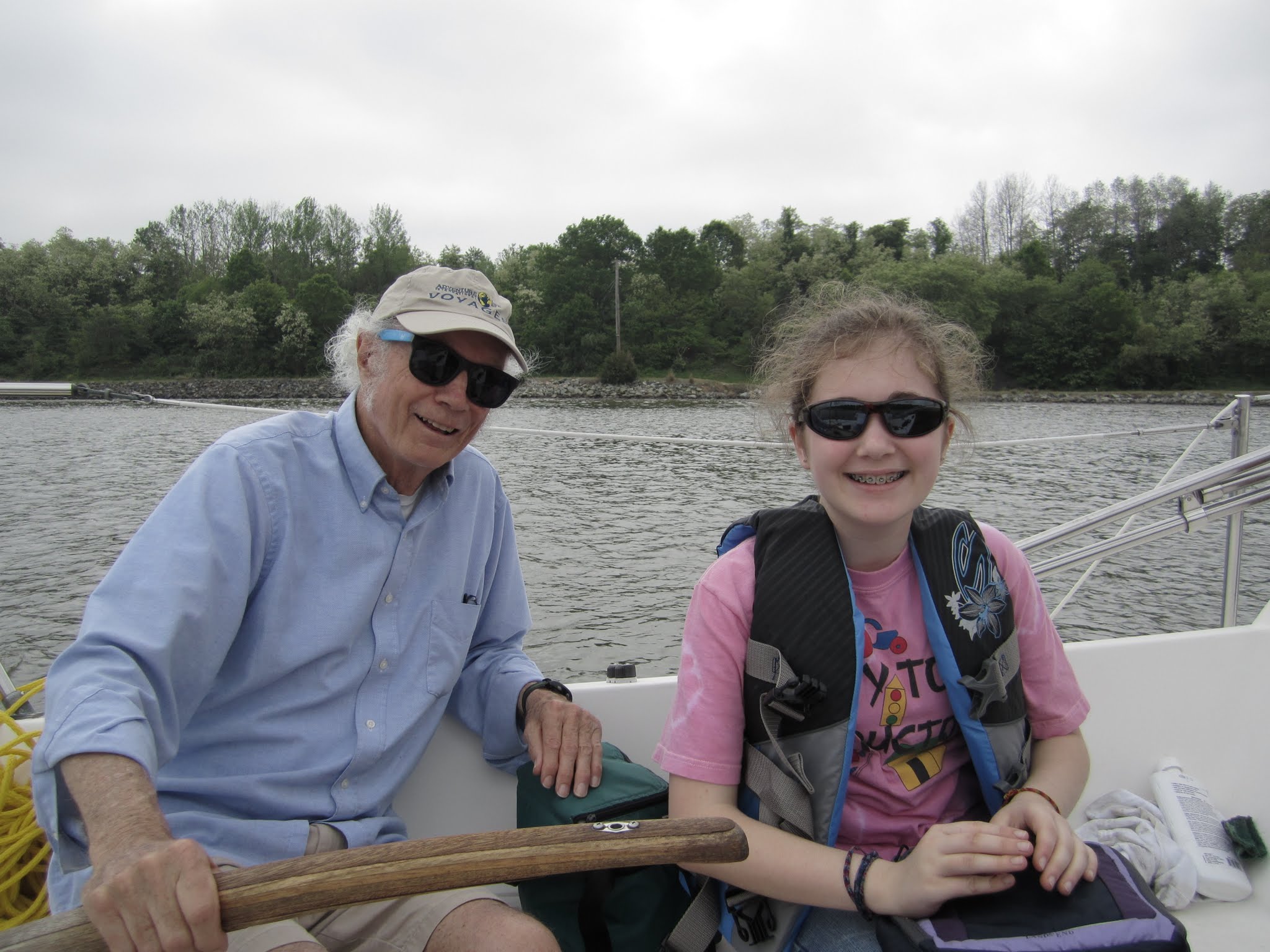
Given the duration of the journey, I asked Dick if he would be willing to join me and my 14-year-old daughter on this first, great adventure in our “new” sailboat, and was delighted when he agreed. There were plenty of things to worry about. In my mind, everything had to go right during the transit, and there were many possible points of failure. For all this, Dick was perfectly at ease as we went along the canal, chatting with my daughter about everything except the transit. Everything went according to plan, and sure enough, about two-thirds of the way along the canal, the engine quit. The first tank had run dry. For the first time ever, I disconnected the first fuel tank, connected the second tank and tried to start the engine. Of course, it didn’t start right up because the engine had run dry. So, I was yanking on a starter cord over and over while our boat drifted down the C&D Canal. Until and unless I could start the engine, we were a navigational hazard to shipping. After what I am sure was less than a minute—though it seemed much longer—the engine started, and I must have uttered a loud sigh of relief. Dick looked at me in disbelief.
“What are you all worried about?!?” When I said something about being concerned that the engine wouldn’t start, he retorted, “You are the skipper of a sailboat. If the engine does not start, we’ve got a sail. If we can’t sail, we’ve got an anchor.” That settled, he resumed his conversation with my daughter. I settled down and starting thinking about the Elk River ahead of us and how we would find our new marina.
It was a lesson I carried with me in every role I have had since that day. Almost as important as being prepared is knowing that you are ready for most outcomes and having confidence in your readiness so that you can maintain perspective on everything else around you.